

Research project
Loss of Control Reform Network
- Start date: 1 July 2025
- End date: 30 June 2026
- Value: £14,920
- Partners and collaborators: Centre for Women’s Justice (CWJ)
- Primary investigator: Dr Laurene Soubise
- External co-investigators: Professor Anna Carline and Dr Sarah Singh (University of Liverpool)
Loss of control is a partial defence to murder, introduced by the Coroners and Justice Act 2009 to replace the former provocation defence. It was intended to better recognise the experiences of victims of domestic abuse while restricting reliance on outdated narratives that excused male violence.
Our research suggests that these objectives have not been fully realised. Analysis of appeal cases indicates that the defence continues to operate in ways that often favour men, while failing adequately to accommodate the realities of domestic and sexual abuse experienced by women. These findings raise important questions about whether the law is achieving its intended aims and whether further reform is required.
The Loss of Control Reform Network was established to examine the operation of the loss of control defence in murder cases and explore options for future reform. Working in partnership with the Centre for Women’s Justice, the project brought together academic research and stakeholder expertise to support informed discussion about the future of homicide law. Through an explainer video, policy brief and research publications, the project sought to make debates about the loss of control defence accessible to a wide audience, including policymakers, legal practitioners, researchers, students and organisations working to address violence against women and girls.
The project’s findings continue to inform discussions about homicide law reform by providing evidence on how the loss of control defence operates in practice and identifying areas where change may be needed. This includes contributions to the Law Commission’s review of homicide law and wider debates about the future of the defence.
Explainer video
How does the law respond when women kill abusive partners? This short animation explores the loss of control defence and the case for reform (available soon).
Resources
Policy Brief: Loss of Control and Domestic Abuse: Recognising the Cumulative Impact of Coercive Control
Why does the loss of control defence continue to operate in ways that disadvantage victims of domestic abuse? This briefing draws on extensive analysis of appeal cases to examine how courts assess loss of self-control and makes recommendations for improving the treatment of domestic abuse evidence within the criminal justice system.
Academic publications:
- Carline, A., Gibson, M., Singh, S. and Soubise, L. (2024) Civilising Loss of Control? The Role of Criminal Justice Gatekeepers. Legal Studies. 44(4): 612–30.
- Carline, A., Singh, S., Soubise, L. and Gibson, M. (2026) Weaponising Relationality? Judicial (Re)Interpretation of Loss of Control in Domestic Homicide Cases. Feminist Legal Studies (forthcoming).
Events and engagement:
In November 2025, the project brought together researchers, legal practitioners and campaigners to discuss the operation of the loss of control defence and opportunities for reform. The event explored how homicide law responds to domestic abuse, coercive control and gendered patterns of violence, and highlighted the challenges faced by women whose experiences of abuse do not fit easily within existing legal frameworks.
To capture the key themes emerging from these discussions, a series of illustrations was commissioned. These illustrations reflect participants’ insights into the realities of domestic homicide, the operation of homicide defences, and the potential need for reform.
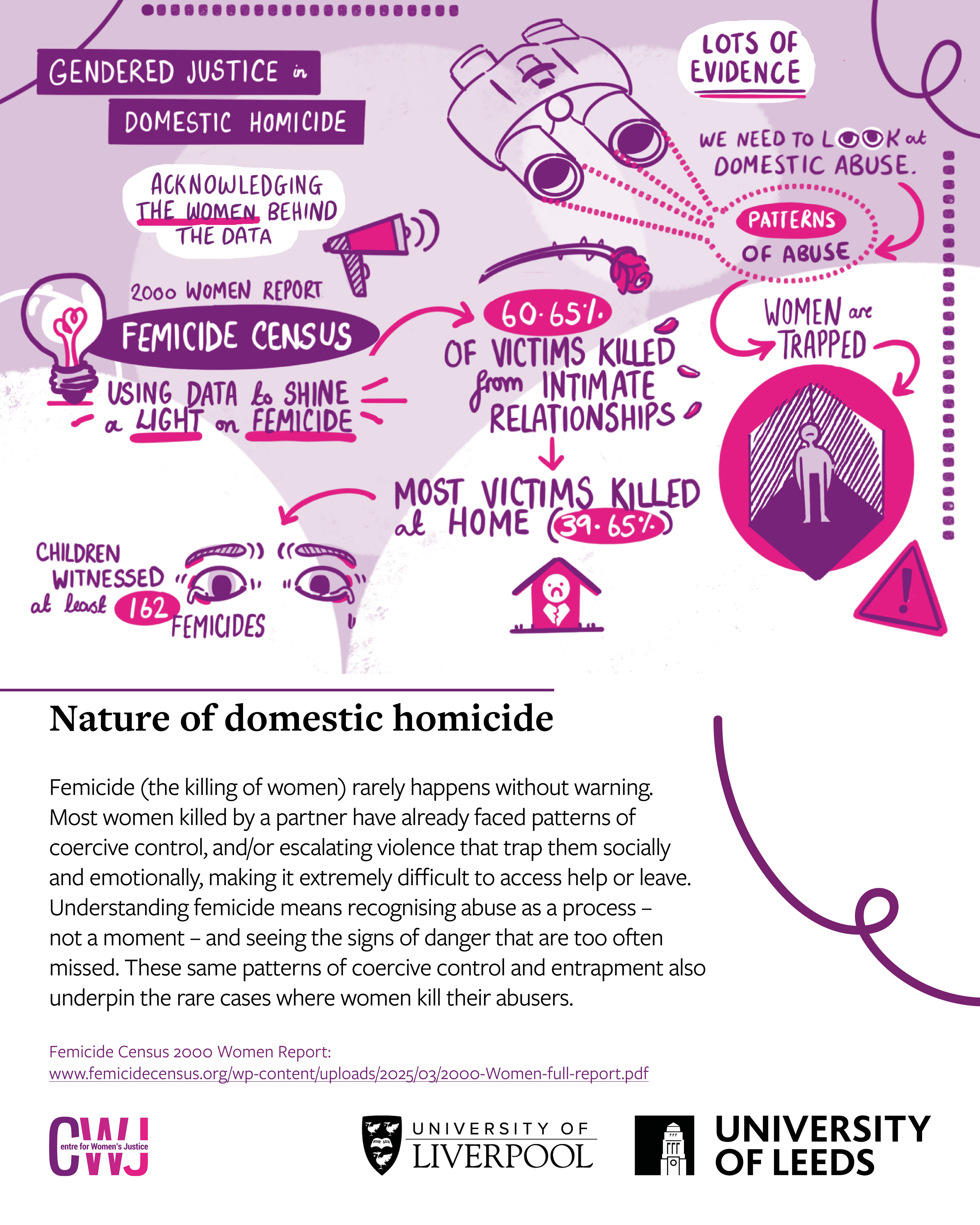
- The nature of domestic homicide
Domestic homicide is often the culmination of patterns of coercive control, entrapment and escalating abuse. This illustration highlights the importance of understanding abuse as a process rather than an isolated incident and shows how these dynamics shape both femicide and the rare cases in which women kill abusive partners.
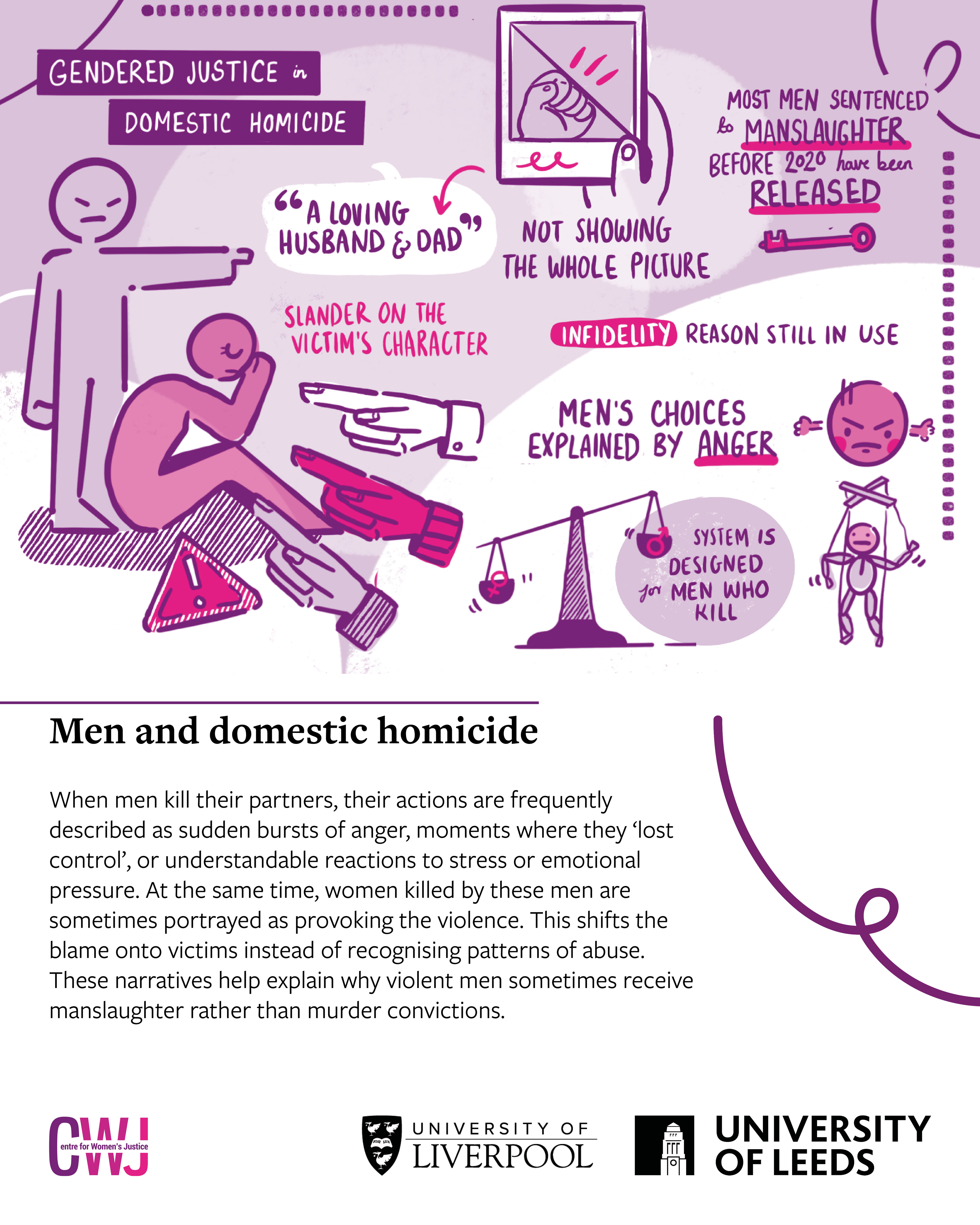
- Men and domestic homicide
This illustration explores the narratives that can emerge when men kill their partners, including assumptions about anger, provocation and loss of control. It invites reflection on how responsibility is framed in domestic homicide cases and how such narratives can influence legal outcomes.
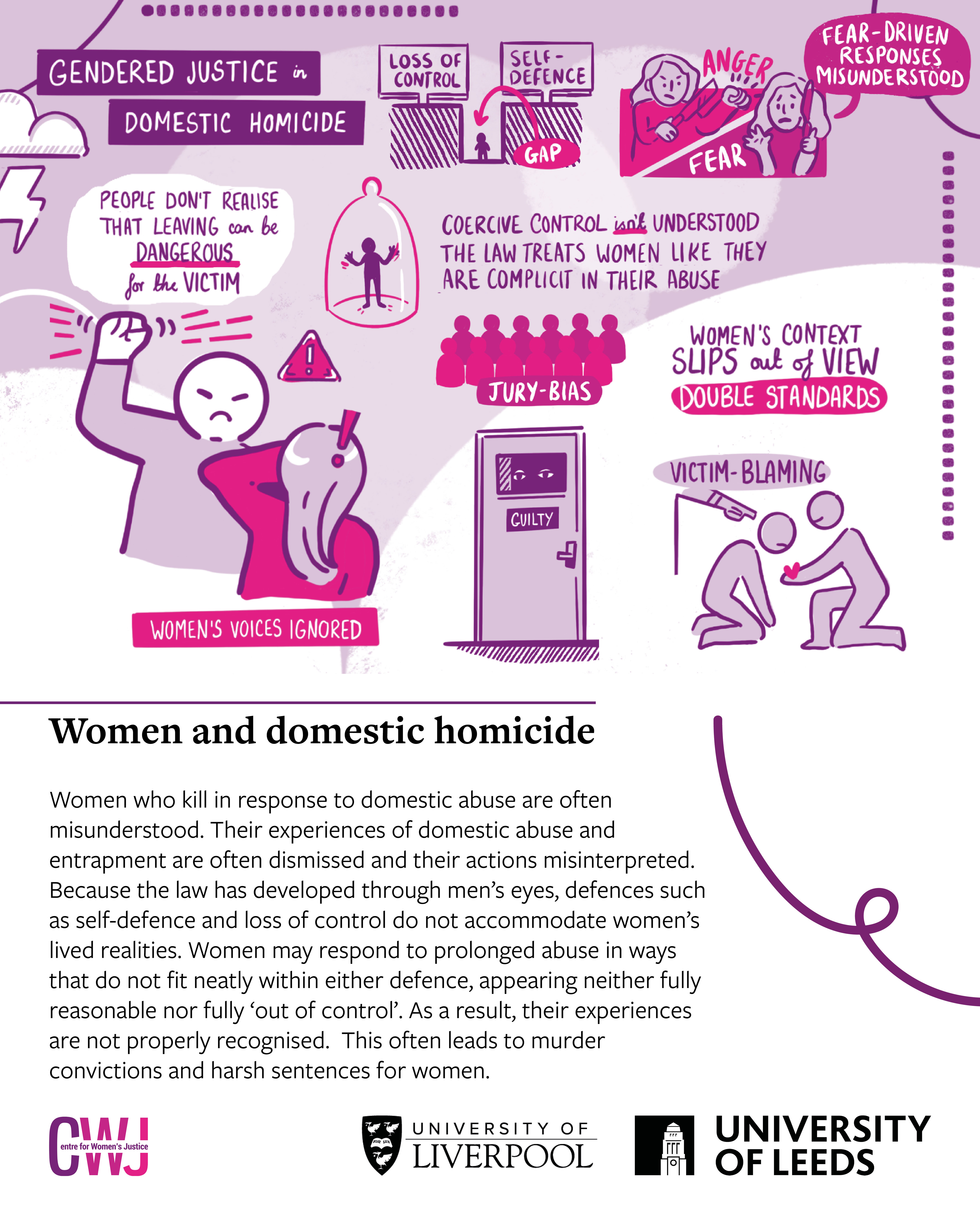
- Women and domestic homicide
Women who kill abusive partners often act in the context of prolonged abuse, coercive control and entrapment. This illustration highlights the challenges women face when legal doctrines such as self-defence and loss of control fail to reflect the realities of their experiences.
Related News and Engagement:
-
Dr Laurène Soubise tackles loss of control defence in Law Commission review of homicide: This article outlines the project's contribution to the Law Commission review of homicide law, including key findings from the research and their relevance to ongoing discussions about reform of the loss of control defence.
- Spotlight on our Research: Dr Laurène Soubise: A broader overview of the research underpinning the project, exploring the origins of the work, its key findings, and its implications for criminal justice policy and practice.
Project Team
Dr Laurène Soubise (University of Leeds)
Associate Professor in Law whose research focuses on criminal justice decision-making, prosecutorial discretion and the operation of the loss of control defence.
Professor Anna Carline (University of Liverpool)
Professor of Law whose research focuses on criminal law, violence against women and girls, domestic homicide, and feminist legal theory.
Dr Sarah Singh (University of Liverpool)
Senior Lecturer in Law whose research examines gender and criminal law, with particular expertise in the criminalisation of abused women and domestic homicide.
Centre for Women’s Justice
A legal charity working to challenge violence against women and girls through strategic litigation, law reform and policy advocacy.
Further information
The Loss of Control Reform Network was established to support informed debate about the operation of the loss of control defence and the future of homicide law reform. The project’s findings continue to contribute to discussions about how the law responds to domestic abuse and gendered violence, including ongoing debates about potential legislative reform.
For further information about the project, its outputs or opportunities for collaboration, please contact Dr Laurène Soubise (University of Leeds).
Project aims
The project aims to foster a national debate on reforming the ‘loss of control’ defence, ensuring it better serves victims of domestic abuse. By raising public awareness, influencing policymakers, and establishing a collaborative network, the project seeks to drive meaningful legal and policy changes that address systemic issues in domestic homicide cases.
Publications and outputs
Carline, A., Gibson, M., Singh, S. and Soubise, L. (2024) Civilising Loss of Control? The Role of Criminal Justice Gatekeepers. Legal Studies. 44(4): 612–30.