Researcher spotlight: Katie Hodgkinson on putting young people at the heart of global development

In our Research Interview Series we hear from researchers across the School of Politics and International Studies making an impact in the field through their areas of expertise.
Here we talk to Dr Katie Hodgkinson at the School of Politics and International Studies about the impact her work is making in education in global development.
Could you describe your latest research?
The research project I’m currently working on is focused on accountability to children and young people in Global Development programming. In such programming, there is generally pressure for organisations to be accountable to the donors and funders who fund programmes, rather than to the people that the programmes are working with and for. This dynamic can be heightened in programmes working with children and young people – where initiatives are often designed ‘for’ rather than ‘with’ young people and consultations with young people can often be tokenistic.
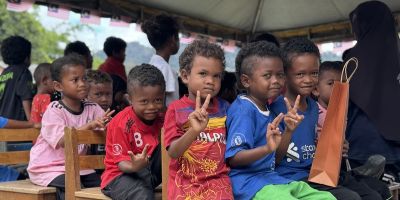
In our current research project, we are working with the organisation Hope and Homes for Children (HHC) to fundamentally change the organisation’s structures of accountability, so that the organisation is first and foremost accountable to the children and young people they work with. It is an interdisciplinary, participatory action research project, centred around co-production methodologies.
We have run a series of in-person and online workshops and summits with children and young people and HHC staff to co-produce a definition of accountability to children and young people, to develop a series of targets and indicators around this, and to build capacity within the organisation and amongst children and young people to embed and advocate for accountability.

How did your research in this area develop?
My work in this area has developed since my PhD – which I also did at the University of Leeds based across the School of Languages, Cultures, and Societies and the School of Politics and International Studies. During this time, I was working on Changing the Story (CTS), a project led by Prof. Paul Cooke (who was one of my two brilliant PhD supervisors, both of whom continue to be amazing mentors to me!).
CTS ran 23 projects in 12 countries, examining how the participatory arts can support youth-centred approaches to civil society building in conflict-affected contexts. My PhD research particularly focussed on projects working at the intersection of the arts and non-formal education and demonstrated that such programmes can politically empower young people and contribute to youth-led social justice.
As well as doing my PhD on CTS, I also worked on the project more broadly through my PhD and later postdoc. Through CTS, we explored what it meant for development to be youth-led, and worked to unpack the structural and organisational changes needed for organisations to be genuinely accountable to young people, including the central importance of engaging young people’s diverse voices, ideas, and knowledges in matters that affect them. You can read our open access book on this, if you’re interested in learning more!

Hope and Homes for Children (HHC) were a part of the CTS network, and Paul worked with them closely through the project.
After CTS, I led a research project in partnership with the British Council titled ‘Non-formal education for youth-led change’ which demonstrated the how embodied and experiential learning through non-formal education programming can help enable young people to enact change in their communities. It also highlighted the need for greater input from young people in programme design, and the need for programmes to be embedded within their communities.
Whilst these research projects have examined different contexts and types of programming, they have all be centred on interdisciplinary and youth-led approaches in global development, which is also the central premise of our current project.
Who is part of your research team?
The research team at the University of Leeds comprises Prof. Paul Cooke and myself – both leading from the academic side – and Dr Sabrina White, an Associate on the project, who runs it and its activities. The three of us come from different disciplinary backgrounds – I’m from the global development space, and particularly education in global development; Paul is based in the Faculty of Arts, Humanities and Cultures, and works particularly in participatory filmmaking in a range of community development and public health contexts. Sabrina’s disciplinary background is in international relations, having done a lot of work on accountability in the context of sexual violence in conflict.
This interdisciplinarity is a key strength of our collaboration and leads to lots of interesting project activities and academic discussions! We work very closely with colleagues based in Hope and Homes for Children (in fact, Sabrina is an employee of both the University and HHC as part of the Knowledge Transfer Partnership that funds the project). From HHC, we collaborate particularly with Victoria Olarte, Senior Strategic Research Partner, and Joe Glackin, Head of Safeguarding and Children’s Accountability. They lead the project on HHC’s side, and we meet them weekly to monitor the project and make key decisions.
We also work very closely with the HHC country teams in South Africa and Rwanda, and of course the children and young people, who are part of HHC’s Our Voices Matter – all of whom are integral to the project.
What are the most significant findings that have emerged?
A key focus of the project so far has been co-developing with children and young people a definition of what accountability means to them. Through this, we have identified that, for an organisation to be accountable to children and young people:
-
children and young people must have safe and meaningful space to participate as partners in decision-making and problem solving about issues that affect their lives;
-
the responsibilities that organisations, and those working and for organisations, have to children and young people must be explicit, resourced and actively upheld;
-
organisations, and those working for organisations, must provide transparent access to information on successes, challenges and failures in responsibilities to children and young people;
-
children and young people must influence decision making and problem solving and must be informed about the impact of their participation;
-
there must be appropriate and viable responses, protections and redress when responsibilities to children and young people are not fulfilled.
We’ve developed this definition into a series of targets and indicators. Our current focus is working with HHC country teams, in partnership with the children and young people, to develop a roadmap for HHC achieving these targets. Sabrina and I recently returned from Johannesburg, where we ran a workshop to support this work. We found HHC staff and children and young people were often on the same page in terms of what this could look like.
How is your research making a difference beyond academia?
This work is oriented around making a difference beyond academia. The purpose of the project is to embed accountability to children and young people into HHC’s systems and structures. The teams in South Africa and Rwanda have already made several changes to their working practice based on the project activities.
Whilst we’re currently doing this work with these two country teams, one of the main outputs from the project is going to be an accountability ‘toolkit’, which other teams can use to follow the processes of the project and embed accountability. We also hope – and believe – that this toolkit will be useful to a wide set of organisations working with children and young people in the development space.
In addition, HHC do a great deal of global advocacy work around childcare reform, and we are working to support this, including contributing to the development of the Global Charter on Children’s Care Reform, launched by the Deputy Prime Minister at the UN General Assembly last year.
What are the next steps for this line of research?
There are a few priorities. We’re aiming to launch the toolkit by the end of 2026, engaging with organisations that work with children and young people throughout. We believe that the toolkit will be of value to many organisations working in the global development space. We will engage donors in these discussions, as they can play a central role in shifting the mechanisms of accountability.
We’re currently seeking further funding to continue developing this work with HHC, in particular to build its focus on advocacy for accountability.
In the longer term, I am keen to take this work into the education field, where I see strong potential. Watch this space…!
Further information
You can read more about the Hope and Homes for Children Knowledge Transfer Partnership here.