

Research project
Listening Beyond Words
- Start date: 1 October 2025
- End date: 31 July 2026
- Funding: University of Leeds Research Equality, Diversity and Inclusion Fund
- Value: £11,779.12
- Primary investigator: Dr Lou Harvey
- Postgraduate students: Jessica Olley (School of English), Johanna Knebel (School of Sociology and Social Policy)
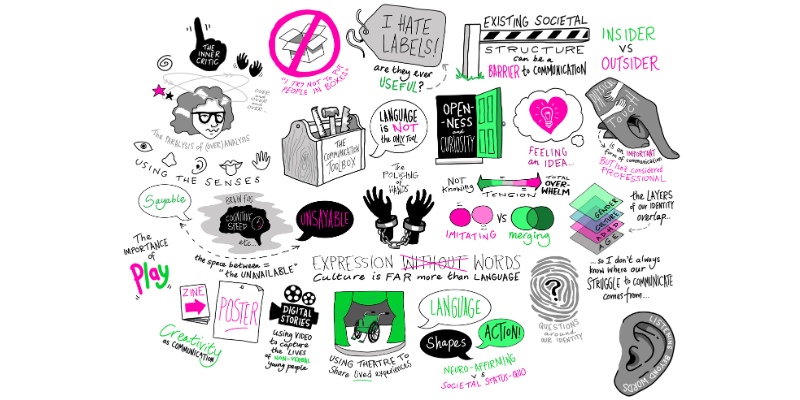
Listening Beyond Words is a programme of research activity mapping a) theoretical and methodological intersections in the fields of neurodiversity studies and intercultural studies, and b) how these fields might inform each other in the service of communicative and knowledge justice.
Neurodiversity studies explores the wide range of ways in which minds work and challenges the idea of a 'normal' way to think or communicate.

Illustrated graphic recording about communication beyond words, identity, neurodiversity and inclusion, using hand-drawn icons, notes and diagrams to show how expression extends beyond spoken language.
Intercultural studies explores how people communicate, interact, and create meaning together across differences, and challenges static and reductive conceptualisations of 'culture'.
Both fields question approaches that treat differences in communication as deficits. When communication is judged only by certain standards – like spoken words, written text, or a specific language – people who express themselves differently can be ignored or dismissed. This creates injustice, because their voices, experiences, and knowledge are pushed to the margins. Listening Beyond Words explores the ways in which these fields think about and research this injustice, and how we can better listen to the unsayable.
Although the project is no longer funded, the network is ongoing and open to new members. If you would like to be included in communication about future activities and events, please get in touch at ListeningBeyondWords@leeds.ac.uk.
Project aims
Listening Beyond Words aims to grow a network of people committed to radically rethinking inclusive communication, asking what kinds of research, collaborations, and creative approaches could emerge when the fields of intercultural studies and neurodiversity studies connect.

Johanna Knebel, Lou Harvey and Jessica Olley standing in front of a large graphic recording display featuring illustrations and notes about communication, identity, inclusion and neurodiversity.
Conferences
In May 2026, researchers, artists, and practitioners gathered for the first Listening Beyond Words symposium. An in-person event was held at the University of Leeds with 35 attendees, and an online event was held the following week for 50 people. Both events were attended by people from across the world, including England, Germany, Italy, Poland, and the US. Live illustration was provided by Beka H, and voice artist Jess Corner ran a voice workshop.
The symposium offered a space to explore different ways of how knowledge can be created and shared through embodied practices beyond traditional, privileged, verbal means of communication. As one attendee reflected:
There was a superbly curated mix of angles and perspectives on the theme, and a refreshing variety of communication modes, all of which resonated with me and my work in so many interesting ways.
Contributions ranged from an invitation to create digital stories of the day to exploring embodied theatre performance techniques, language 'impairment', a hauntological film critique of the pathology paradigm, an introduction to post-dramatic theatre, and a reflection on the normative culture of swimming pools. This facilitated critical engagement with topics such as the importance of touch in communication and the importance of communicative agency.
Our movement-based activities disrupted normative notions of academic time and space by explicitly encouraging participants to get up, move around, fidget, and even play with toy cars, not only during breaks but as part of thinking and sensing together. This also facilitated animated reflections on the in/accessibility of academic spaces which often require sitting still for long periods of time whilst following verbal presentations.
Accessibility was integral to planning, organisation and facilitation. This included distributing a detailed information booklet before the event, incorporating a break after each set of presentations and before the Q&A, leaving time to process information and encouraging moving around, fidgeting, and scribbling on tablecloths. This set the tone for a day of free communication and mutual recognition:
The schedule, especially the short breaks after each set of presentations and before questions, meant that I didn't get overwhelmed and was able to gather my thoughts before the questions. As a result, I retained so much more information than I normally do at events. Also, I didn't suffer from those sleepless nights afterwards where I wake up in the middle of the night and spend hours thinking about and sorting through all the information overload and wishing I'd said X or asked Y. A revelation!
I usually find busy crowded rooms, long presentations and the pressure to be social too much, so I stand near the door and leave at the earliest opportunity. Today, nobody chivvied me to a table and forced me into unwelcome small talk. I felt absolutely at home to get up and wander round if I needed to, to choose whether or not to participate, to fidget, to have whatever expression on my face I felt like. For the first time in my life, I was in a room with bright, enthusiastic, articulate people who had given themselves permission to be openly neurodivergent and take whatever space they needed. For this profoundly moving experience I am very grateful.
In the words of one of the participants: it was a truly inspiring day, full of stimulating discussions and meaningful reflections. Huge thanks to all contributors and attendees for their lively participation and thoughtful engagement.

Illustrations from conference participants, including an abstract human-shaped figure divided into 12 numbered sections like a clock (left), abstract doodle pattern of interconnected curved and angular shapes like a maze (centre) and illustrated map of ideas about inclusion and neurodiversity, featuring a winding path, stage curtains, a racing car, camera, network diagram and handwritten reflections on communication, support and community (right).